
 UncensoredView
Explore the best uncensored AI image and video generators of 2026. See why UncensoredView delivers superior unrestricted NSFW creation with no filters. Try free today!
 NSFW AI Video
Generative AI has been revolutionized by 2026. Though mainstream companies are still using rigorous content filters, a completely different generation of AI image and video generation tools has come into existence and has become extremely popular. There is an increasing need for creators, artists, pornographers, and even users who want to keep their creations free from all restrictions, that are imposed by the invisible filters like prompt scanners, output classification, and banning of the user's account. This is done even when the content is legal.
This guide examines what “uncensored” truly means in practice, why major platforms maintain aggressive filtering, the practical criteria that separate strong tools from limited ones, and how the current generation of platforms performs. It also highlights why platforms focused on seamless, restriction-free workflows—particularly UncensoredView—address the core frustrations that drive users toward specialized uncensored solutions.
“Uncensored” does not describe a fundamentally different underlying model. Open-source foundations such as variants of Stable Diffusion, Flux derivatives, Wan-based video architectures, and other advanced diffusion or generative models can power both heavily moderated and unrestricted interfaces. The decisive difference lies in the product layer: the absence of keyword blocklists, real-time prompt scanners, output classifiers that refuse or alter results mid-generation, and punitive account policies.
NSFW (Not Safe For Work) content refers to adult, explicit, or mature material featuring fictional consenting adults. An uncensored generator simply allows the model to produce such output when prompted, rather than intercepting the request or post-processing the result into a censored or refused state. Soft censorship—where a tool appears to accept a prompt but then softens anatomy, clothing, lighting, or motion to avoid explicitness—remains a common complaint even on some “NSFW-friendly” platforms. True uncensored tools minimize or eliminate these interventions so that prompt adherence remains high across photorealistic, anime, stylized, and cinematic outputs.
This distinction matters for both image and video. Image generation has been relatively mature for years; unrestricted video, especially image-to-video pipelines that preserve identity, clothing, lighting, and scene consistency, is more demanding and therefore rarer among hosted services.
Major platforms maintain filters for structural business reasons rather than pure technical necessity. Midjourney enforces a strict PG-13 standard with automated classifiers and escalating bans. OpenAI’s DALL·E blocks explicit prompts and outputs at the API level. Runway prohibits nudity and sexually explicit content while scanning both inputs and outputs. Kling and similar commercial video tools operate under zero-tolerance policies with no user toggle. These decisions protect advertiser relationships, app-store compliance, payment-processor requirements, and legal exposure for venture-backed companies.
The practical result is that a prompt describing a consenting adult scene, artistic nude, or stylized mature concept frequently triggers refusals, silent modifications, or account risk. Users who need reliable output for legitimate adult creative work, private exploration, or commercial projects involving fictional adult subjects therefore migrate to specialized uncensored platforms. The gap is not merely philosophical; it is operational. When a tool repeatedly interrupts the creative loop, productivity collapses.
Selecting the right platform requires looking beyond marketing claims. The following factors consistently separate capable tools from incomplete ones:
Combined image and video capability. Many platforms excel at still images but offer only short, inconsistent, or heavily limited video clips. True image-to-video pipelines that maintain facial identity, outfit continuity, lighting, and natural motion across clips are significantly more valuable.
Style range and prompt adherence. Support for photorealistic, anime, illustrated, cinematic, and hybrid styles within the same interface reduces tool-switching. Strong prompt adherence means the model follows detailed descriptions of pose, expression, clothing, lighting, and camera movement rather than defaulting to safer interpretations.
Character and visual consistency. Features that preserve identity across generations—whether through reference images, templates, or dedicated modes—enable series work, storytelling, and reusable characters.
Privacy and payment flexibility. Default private generation, minimal data retention, and options such as crypto or discreet billing reduce exposure. Pay-per-use or credit systems often suit occasional users better than forced subscriptions.
Workflow efficiency. An all-in-one environment that supports generation, regional refinement or editing, template-based starting points, and direct animation into video minimizes context switching.
Hosted convenience versus local control. Hosted platforms trade some control for speed and accessibility. Self-hosted stacks (Automatic1111, Forge, ComfyUI with community checkpoints, or local Wan implementations) offer maximum freedom and privacy once a capable GPU is available, but they require setup time and hardware.
Platforms that score well across multiple of these dimensions reduce friction for both casual experimentation and sustained creative production.
Among current options, UncensoredView stands out for addressing the most common points of failure in uncensored workflows. It functions as a dedicated NSFW AI image and video generator that prioritizes the absence of soft censorship and mid-prompt refusals. Users can generate realistic AI nudes, custom NSFW art, and explicit scenes from text prompts or reference images without the tool rewriting or blocking the request.
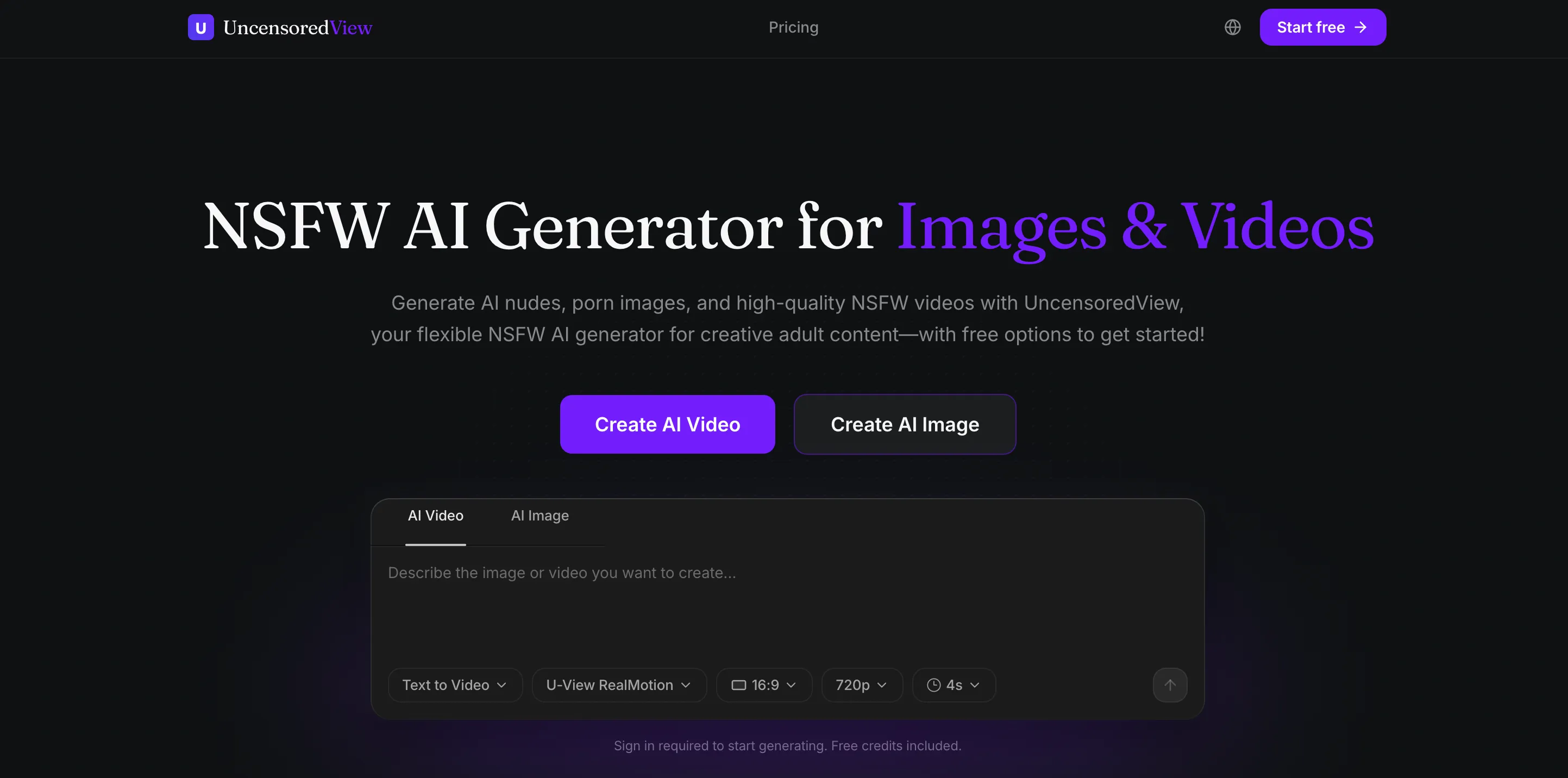
Key capabilities include photorealistic, anime, and stylized outputs with strong prompt adherence; AI image editing that allows refinement of adult content with full creative freedom; and image-to-video conversion that turns stills into smooth clips while preserving consistent faces, outfits, and lighting. Text-to-video and image-to-video pipelines both support explicit scenes that many other platforms block outright. Templates spanning Anime, Fantasy, Character, Fashion, Portrait, Artistic, Cinematic, Romantic, and related categories provide structured starting points that can then be adapted with custom prompts and references.
A distinctive feature is Celebrity Mode, which is rarely available on competing AI video generators and expands creative options for specific use cases. The overall workflow is deliberately simple: create an account (new users receive free credits), describe an idea via prompt or uploaded reference and select a style template, generate and refine by adjusting prompts or regenerating specific regions, then animate the preferred image into a video clip and export privately in full resolution. This keeps generation, refinement, and animation inside one environment rather than requiring multiple tools.
Privacy is emphasized: prompts, uploaded images, and generated NSFW content remain private. The platform’s design reduces the risk of soft censorship interrupting the creative flow, which is a frequent complaint on tools that claim to be unrestricted yet still intervene. Testimonials from users highlight reliable nude and explicit detail generation without refusals, functional image-to-video with smooth motion, and the practical advantage of an all-in-one setup with stronger privacy characteristics than many alternatives.
For creators who previously abandoned projects because a mainstream tool refused a prompt or a partial uncensored service produced inconsistent video, UncensoredView’s combination of unrestricted generation, visual consistency, templates, and seamless image-to-video offers a more reliable production path. Explore the full capabilities at UncensoredView to see how the workflow operates in practice.
Reference roundups of uncensored tools in 2026, such as those evaluating hosted and self-hosted solutions, consistently note that unrestricted video remains rarer and more valuable than unrestricted images. Platforms like NoCensor AI have been positioned as strong all-in-one picks because of Wan-based video, continue-from-last-frame chaining, reusable face models, private-by-default generation, and low-entry credit pricing with crypto options. Self-hosted Stable Diffusion or ComfyUI stacks provide zero filters and complete local privacy once hardware is available, though they demand technical setup. Other services emphasize community LoRA libraries (SeaArt), anime-focused quality (PixAI, with realistic NSFW restrictions), try-before-you-pay credit grants (Mage.space), or operator-level prompt privacy (Venice AI, often with higher subscription costs for NSFW access).
UncensoredView differentiates itself through its explicit focus on eliminating soft censorship during both image and video stages, strong consistency of faces/outfits/lighting in image-to-video, ready-made style templates that accelerate direction-setting, and features such as Celebrity Mode. The free credits for new accounts lower the barrier to evaluation, while the all-in-one design avoids the fragmentation common when users combine a separate image generator with a limited video tool. Where some platforms excel in one dimension (community models, absolute local control, or ultra-low per-run API pricing), UncensoredView prioritizes practical reliability for creators who need both high-quality stills and coherent short video clips without repeated refusals or quality drops.
Users optimizing for maximum control and zero ongoing cost may still prefer a properly configured local stack. Those seeking the lowest possible friction for occasional image-to-video work with reliable unrestricted output often find the hosted all-in-one approach more productive. In either case, verifying current policy and geo-availability remains advisable, as the space continues to evolve quickly.
Legitimate applications include adult content creators producing material with fictional consenting adults, independent artists exploring mature themes without PG-13 constraints, private users who prefer not to have prompts logged on mainstream platforms, and developers building applications that require unrestricted generation. Style exploration—testing photorealistic, anime, painterly, or cinematic treatments of the same concept—benefits from platforms that maintain prompt fidelity across modes.
At the same time, freedom from content filters does not override legal boundaries. Sexual content involving minors is illegal everywhere, as are non-consensual depictions of real, identifiable people. Reputable platforms and responsible users maintain these lines. Outputs should be treated according to the specific tool’s terms and applicable model licenses before commercial use. Privacy practices also vary: local self-hosting offers the strongest isolation, while well-designed hosted services that default to private generation and minimize data retention provide a practical middle ground for most users.
What makes an AI image or video generator truly uncensored?
It removes or minimizes the moderation wrapper—prompt scanners, output classifiers, and refusal mechanisms—so the model can produce mature or explicit content of fictional adults when prompted, without soft rewriting of anatomy, clothing, or motion.
Why do many users still encounter filters on “NSFW” platforms?
Soft censorship and inconsistent classifiers remain common. A tool may accept a prompt yet produce toned-down results or refuse mid-generation. Platforms designed specifically around the absence of these interventions reduce that friction.
Is unrestricted video generation widely available?
No. Most hosted tools remain stronger on still images. Image-to-video that preserves identity and scene consistency while supporting explicit content is a differentiating capability.
How should I evaluate privacy?
Consider whether generations are private by default, what data is retained, payment options (including crypto or discreet descriptors), and whether prompts stay local. Local self-hosting eliminates operator exposure entirely.
Can I start without a large commitment?
Many platforms, including those offering free credits on signup, allow evaluation before paid use. Pay-per-use or non-expiring credit models generally suit intermittent creators better than mandatory subscriptions.
The demand for uncensored AI image and video generators in 2026 reflects a clear mismatch between mainstream platform policies and the needs of users creating legal adult or mature content. Removing the moderation layer restores prompt fidelity, enables consistent visual storytelling, and supports both still and motion workflows that would otherwise be interrupted.
UncensoredView addresses these requirements through unrestricted generation without soft censorship, seamless image-to-video with preserved consistency, practical templates, editing flexibility, privacy defaults, and an all-in-one workflow that keeps creators inside a single environment. Combined with free credits for new accounts, it lowers the barrier to testing high-quality NSFW image and short video production. For users comparing options across hosted convenience, character consistency, and actual freedom from refusals, it represents a focused solution rather than a partial workaround.
To experience the difference in practice, visit UncensoredView and start generating with the free credits available to new accounts. The right tool is ultimately the one that lets you move from idea to refined image to coherent video without the constant interruptions that define restricted platforms. For additional context on the broader category of unrestricted tools, see industry comparisons such as those published on jsmanifest.